
AI SEO is changing how search engines understand intent, relevance, and content in modern digital marketing. Search engine optimization is no longer driven only by keywords, backlinks, and technical checklists. Artificial intelligence now plays a central role in how search systems interpret queries, evaluate pages, and decide rankings.
This shift is not theoretical. It is already visible in how search engines behave today. AI-driven search systems learn continuously from user behavior, content quality, and context, making SEO more dynamic and system-based than ever before. This article explains seven practical ways AI is changing how search really works and what this means for SEO going forward.
Contents
- 1 1. AI Understands Search Intent Better Than Keywords
- 2 2. AI Uses User Behavior as a Core Ranking Signal
- 3 3. AI Connects Content Through Topics, Not Individual Pages
- 4 4. AI Turns SEO Into a Continuous Learning System
- 5 5. AI SEO Follows the Same Logic as Performance Marketing
- 6 6. AI Agents Are Reducing Manual SEO Work
- 7 7. AI SEO Rewards Clarity, Structure, and Usefulness
- 8 Why AI SEO Requires a Different Mindset
- 9 What This Means for AI SEO in 2026
- 10 What Is Likely to Happen Next
- 11 Final Thoughts
1. AI Understands Search Intent Better Than Keywords
Traditional SEO relied heavily on keyword usage. If a page included the right keywords in the right places, it had a higher chance of ranking. While this approach worked earlier, it struggled to handle complex and conversational searches.
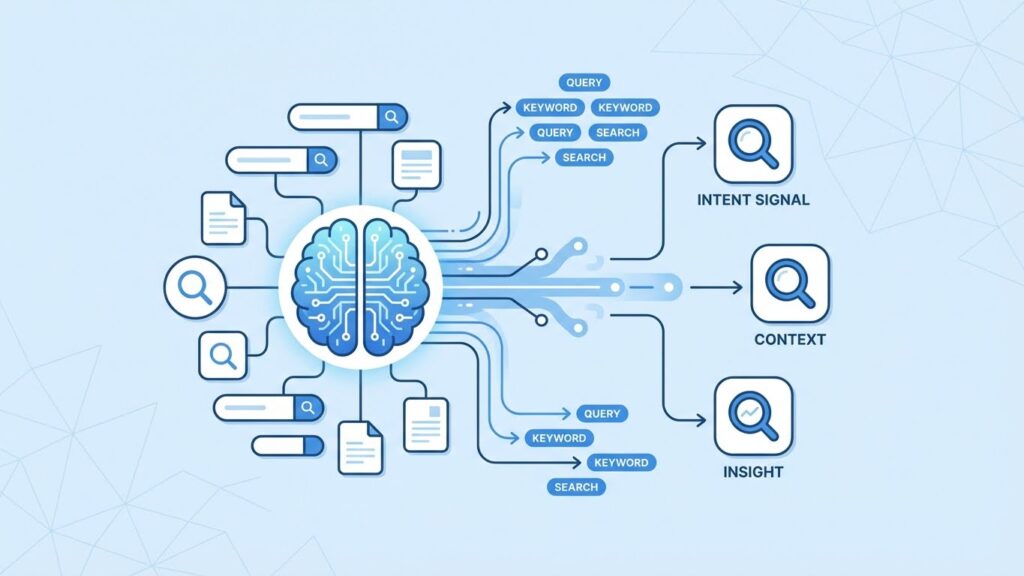
AI changed this model by enabling intent-based search. Modern search engines can understand what a user actually wants, even when the query is vague or does not contain exact keywords. AI evaluates the meaning behind a query, the problem being solved, and the context of the search.
Because of this, content can rank without repeating keywords word for word. AI SEO prioritizes relevance and clarity over keyword matching, making intent understanding a foundational ranking factor.
2. AI Uses User Behavior as a Core Ranking Signal
AI SEO depends heavily on how users interact with search results. Search engines continuously observe user behavior such as clicks, time spent on a page, scrolling patterns, and whether users return to the search results.
When users engage positively with content, AI systems interpret this as a signal of relevance and usefulness. When users leave quickly or fail to find answers, rankings adjust over time. This behavior-based evaluation makes SEO more performance-driven and less dependent on static rules.
As a result, content quality and user experience play a much stronger role in AI-driven search systems.
3. AI Connects Content Through Topics, Not Individual Pages
Earlier SEO treated each page as a separate entity. Optimization focused on ranking individual URLs for specific keywords.
AI SEO takes a broader view. AI systems analyze topic relationships, content depth, and authority across an entire website. Instead of evaluating pages in isolation, AI looks at how well a website explains and supports a topic overall.
Websites that cover subjects comprehensively tend to perform better than those publishing disconnected articles. This is why topical authority is becoming more important than single-page optimization in modern SEO.
4. AI Turns SEO Into a Continuous Learning System
SEO is no longer a one-time setup. AI-driven search works as a continuous learning loop that never stops.
Search systems observe user behavior, evaluate relevance, adjust rankings, and learn from outcomes repeatedly. This process runs continuously, which explains why rankings can change even when content remains unchanged.
As user expectations evolve and new content enters the ecosystem, AI systems adapt automatically. SEO today is dynamic because learning is built into the system itself.
5. AI SEO Follows the Same Logic as Performance Marketing
AI SEO shares strong similarities with performance marketing. Both rely on data, experimentation, and continuous optimization rather than fixed assumptions.
Instead of setting rules once, AI evaluates real-world outcomes and adjusts decisions based on performance. Because of this, SEO is becoming more closely connected with analytics, content strategy, and paid marketing.
AI reduces the gap between organic and performance channels by applying the same behavior-driven logic across digital marketing systems.
6. AI Agents Are Reducing Manual SEO Work
AI agents are increasingly used to support SEO tasks such as content analysis, performance monitoring, and structural evaluation. These systems can identify optimization opportunities faster than manual reviews.
While humans still control strategy, creativity, and quality standards, AI agents reduce repetitive and time-consuming work. This improves efficiency and allows marketers to focus more on planning, decision-making, and long-term growth.
AI SEO does not remove human involvement. It changes how effort is distributed.
7. AI SEO Rewards Clarity, Structure, and Usefulness
One of the most important changes AI brought to SEO is a renewed focus on clarity. Clear explanations, logical structure, and genuinely helpful content perform better than over-optimized pages.
AI-driven search systems are designed to reward content that solves real user problems. Manipulative tactics and keyword-heavy content gradually lose effectiveness as AI prioritizes usefulness and relevance.
This shift encourages better content practices and long-term trust building.
Why AI SEO Requires a Different Mindset
AI SEO requires marketers to think beyond traditional optimization techniques. Instead of focusing only on rankings and keywords, the emphasis shifts toward understanding users, intent, and information quality.
Search engines powered by AI reward content that explains topics clearly and demonstrates expertise. SEO strategies must align more closely with user experience, topical depth, and system-level thinking rather than isolated tactics. Over time, this approach builds stronger trust with both users and search engines.
What This Means for AI SEO in 2026
AI SEO is raising the standard for search optimization. Websites that want sustainable visibility must focus on intent, topic coverage, user experience, and continuous improvement.
SEO is no longer about gaming algorithms. It is about aligning content with how AI understands information and how users search in real life.
What Is Likely to Happen Next
Based on current search engine behavior, AI investment trends, and user adoption patterns, AI-driven intent optimization is very likely to become a baseline requirement for SEO, with an estimated probability of around 80–90%. Search engines are already deeply invested in artificial intelligence, and user search behavior is becoming more conversational and context-driven. Compared to traditional rule-based SEO, AI-based systems consistently deliver higher accuracy and more relevant results, making this shift highly likely to continue.
Final Thoughts
AI SEO is not a temporary trend or a shortcut. It represents a structural change in how search engines work and how content is evaluated. As AI-driven systems become better at understanding intent, relevance, and context, traditional SEO methods alone are no longer enough to sustain visibility.
Websites that understand this shift and adapt their SEO strategy around intent, clarity, and system-level thinking are better positioned for long-term growth in AI-driven search environments. This often requires moving beyond basic optimization and adopting more intelligent, data-informed approaches to search and content, which is the core philosophy behind how we approach AI-driven marketing systems.
For businesses looking to implement these changes effectively, working with structured AI SEO strategies can help align content, technical foundations, and search intent more accurately . Instead of chasing short-term ranking tactics, the focus shifts toward building search systems that evolve alongside AI-powered search engines.
In practice, this also means integrating SEO with broader AI-driven marketing efforts, where search, content, automation, and performance data work together as a single system. This approach helps brands build sustainable visibility, improve relevance, and stay competitive as search continues to evolve.